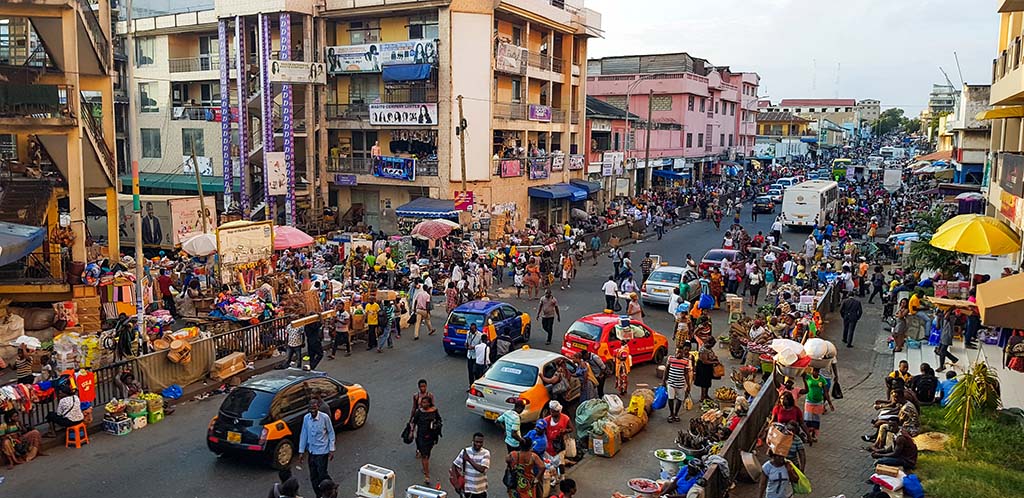
It was a dark evening of the day on June 3rd 2015 with over 150 confirmed deaths in Accra. The disaster which caused major damages to transport, human mobility, water and sanitation affected an estimated 53,000 people. The World Bank estimated the reconstruction cost at $105 million. The popular Odaw River Basin (ORB) is marked as flood prone due to the impact of poor solid waste management, huge informal settlement with low income, and climate change.
Two years after the June 3rd disaster, two important documents have been commissioned including a-20 year Greater Accra Spatial Development Framework (2017 – 2037) and City Strength Diagnosis (2017). These documents informed the Greater Accra Resilient and Integrated Development (GARID) project. In order to mitigate flood disaster and risk, and improve solid waste management, the government was granted a loan of $200 million from the world Bank for the GARID.
In accordance to article 181 of the 1992 constitution, on the 4th December 2023 in parliament, Ghana’s government requested for an additional financing of $150 million. This loan on 19th March 2024 was approved by the Finance Committee of parliament and signed by the Chairman of the Committee, Hon. Kwaku A. Kwarteng.
Original Financing of GARID
The flood in Greater Accra have led to the loss of hundreds of lives, affecting livelihoods and housing. The GARID project was expected to mitigate the impact of floods and waste management on families, and businesses along ORB in Accra. With a loan of $200 million, it is estimated that about half a million people of low-income will benefit from this intervention. The GARID has 5 components with related cost. The Climate Drainage and Flood Mitigation Measures, Solid Waste Management Capacity Improvement, Participatory Upgrading of Targeted Flood Prone Low-income Communities and Local Government Support, Project Management, and Contingent Emergency Response Component with each costing $92 million, $42.2 million, $58.8 million, $7 million and $0 million respectively.
Why the Additional Financing?
At the peak of the COVID-19 waves and related expenditure, the government’s emergency response program led to the transfer of $65 million from the Climate Resilient Drainage and Flood Mitigation Measure. The component 5 which had no cost of allocation received $65 million from component 1 through negotiations between the government and the World Bank. After the disbursement of funds for the project implementation, $40.4 million was left as uncommitted amount. An amount of $18.9 million was paid as Metropolitan, Municipal and District Assembly (MMDA) grant, and $5 million in exchange losses from the uncommitted amount.
Only $16.3 million is left as the uncommitted amount which is insufficient to complete the GARID project. Again, the initial loan of $200 million did not include the payment of compensations to affected persons. This additional financing of $150 million will address the financing gap of component 1 of the $65 million disbursed for the government’s COVID-19 Response Program. As a result of inflation, the cost of the project is affected and this has also necessitated the request for the loan. Although against the World Bank’s policy to use loans to compensate project affected persons, the government compelled the bank to waive its rules for the additional financing, especially to pay compensations to affected persons.
This additional financing loan has a 25-year payment period with a grace period of 5 years. With a grant element of 21.3%, interest and service charges of 1.39% and 1.34% respectively. The project which is expected to be completed in December 2025 has been extended to December 2027. The $65 million for the COVID-19 Emergency Response Program obviously delayed affected the implementation of the project.
Ghanaian taxpayers should be ready to pay $150 million in taxes for 25 years. Although a great opportunity for government to continue the GARID project it is imperative to avoid the delays in all project implementation and completion in future. It adds to the debt of the country.
Peter Bismark Kwofie
Executive Director, Institute for Liberty and Policy Innovation
Tema
Photo credit: