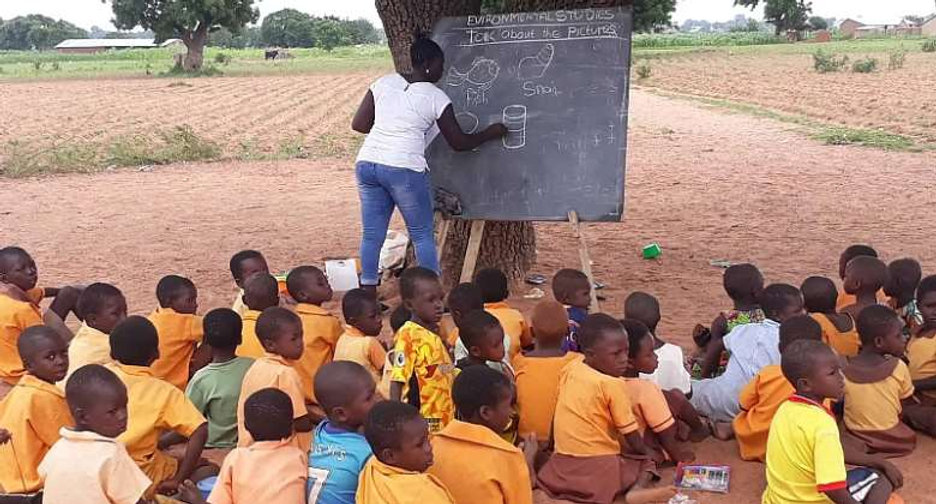
Across many rural and underserved regions in Ghana, “schools under trees” remain a familiar sight — children learning in the open, often with nothing more than a blackboard propped against a tree and a committed teacher impacting knowledge. These makeshift classrooms are typically seen as temporary fixes to infrastructural deficits.
But what if we looked at them differently?
Taking inspiration from Denmark’s forest school model, Ghana has a unique opportunity to reimagine these outdoor classrooms as intentional, pedagogically rich, and culturally rooted learning environments. With visionary policy direction, strategic investment, and professional support, these spaces could serve as models for experiential, inclusive, and locally relevant education — not just stop-gap solutions.
In Denmark, the forest school approach is a well-established educational model where children learn with nature — among trees, fields, and streams. Here, nature becomes an active teaching tool: students explore ecosystems, study weather patterns, compose nature-inspired stories, and practice mathematics through real-world measurement.
This method fosters creativity, environmental stewardship, critical thinking, physical activity, and emotional resilience. It also challenges the conventional belief that quality education must always occur within four walls.
Ghana’s Local Reality: A Foundation Already Exists
Ghana does not to replicate the Danish model in wholesale. In many respects, a version of it already exists in the form of “schools under trees.” The challenge — and opportunity — lies in formalizing and enhancing this reality into a purposeful model of outdoor education.
The Ministry of Education can develop a contextualized outdoor learning framework aligned with national curriculum standards and Ghana’s ecological and cultural diversity. Examples include:
- Science: Tree growth observation, soil testing, biodiversity mapping.
- Mathematics: Estimating distances, geometry using leaves and sticks.
- Language & Literacy: Nature journaling, oral storytelling, descriptive writing.
- Environmental Studies: Waste management, climate awareness, conservation.
This approach can promote interdisciplinary learning, creativity, and critical thinking while strengthening children’s connection to their environment.
2. Empower Teachers through Training and Resources
Teachers are pivotal to transforming outdoor learning into a viable model. Policymakers and teacher education institutions should, embed outdoor pedagogy into pre-service and in-service teacher training, provide practical toolkits (chalk, mats, waterproof books, etc.) using locally available materials, create teacher peer networks to share practices, challenges, and innovations.
With professional support, teachers can become catalysts for experiential, resilient education in even the most resource-limited settings.
Outdoor learning opens space for meaningful community engagement. Policy frameworks and should encourage the following:
- Intergenerational learning: Elders sharing local history, farming, and cultural traditions.
- Community-school partnerships: Parents and local leaders maintaining learning environments (e.g., clearing grounds, planting shade trees).
- Culturally relevant content: Teaching in local languages and integrating indigenous knowledge systems.
This collaborative model fosters ownership and reinforces the value of education within communities.
While long-term infrastructure development remains essential, interim investments can enhance learning experiences. This includes, plant shade trees or install mobile canopies, use weatherproof teaching materials and secure storage units, and demarcate safe outdoor learning spaces with basic seating and natural boundaries.
These improvements help ensure dignity, safety, and continuity of learning without waiting for permanent buildings.
Shift the Narrative Around “Schools Under Trees”
Governments, Non-Governmental Organizations (NGOs), and development partners must reshape public perception of outdoor learning. Rather than viewing “schools under trees” as failures, they should be seen as adaptive, innovative responses in line with global priorities like climate resilience, sustainable education, and inclusive learning.
Awareness campaigns, pilot programs, and documentation of success stories can help reposition these settings as sites of possibility rather than deficit.
Additionally, Ghana’s Ministry of Education, in partnership with Ghana Education Service and District Assemblies can create policy guidelines for outdoor learning—including standards for safety, curriculum alignment, and community collaboration.
A Green Print for Ghana’s Education Future
Ghana’s education challenges are real, but they are also opportunities to lead with innovation. By formalizing outdoor learning models rooted in local contexts, we can transform necessity into a vision for the future.
The “Schools Under Trees” should not be dismissed as relics of neglect, for they can become vibrant centers of learning, community engagement, and environmental connection.
This could also align with the Ghana Education Strategic Plan (ESP) 2018–2030, which emphasizes equity, inclusion, and quality as core pillars. Outdoor learning speaks to all three —offering access to those in infrastructure-poor settings, embracing cultural learning forms, and enhancing pedagogy.
With the right support, Ghana can chart a bold new course, leading to an education system that is not only resilient and inclusive, but also attuned to its people, land, and future.
Kwadwo Darkwa Essel
Education Policy Analyst & Curriculum Specialist
Article Image Source: https://www.schoolforlifegh.org/post/it-will-take-240-years-to-eliminate-schools-under-trees-in-ghana
Disclaimer:
The views and opinions expressed in this article are those of the author and do not necessarily reflect the official policy or position of the Institute for Liberty and Policy Innovation (ILAPI). While every effort is made to ensure accuracy, ILAPI is not responsible for any errors or omissions, or for any losses, injuries, or damages arising from the use of this information.