Economic freedom, most importantly the removal of barriers to enterprise establishment and transition, lower government spending and curtailing of wasteful spending, offers the reduction in poverty and increase in prosperity. High levels of regulations are burdens on Africa's state economies.
The African Continental Free Trade (AfCFTA) which was launched during the 10 th Extraordinary Session of the African Union (AU) Summit on the 22 nd March 2018, saw 44 African leaders accenting to the Kigali Declaration. This free trade agreement is estimated to drive Africa's GDP to $3.4 trillion to boost economic growth.
In Africa, countries barely trade among each other with a 14 percent intra-trade between AU's member countries. For example, Kenya's exports to Ghana in 2021 were valued at only $10.3 million. Malawi's export to Tanzania is only a little over $20 million annually. It is not that Africans cannot trade among themselves but because governments do not want them to do business and trade.
Trade volumes within Asia, Europe and North-America are higher than within Africa.

WTO
Removing Barriers for Trade in Africa
The Managing Director of the International Monetary Fund (IMF) opined that "African governments must remove trade barriers to increase the continent's per capita income. Operating a free trade market will push up the per capita income of an African country by more than 10 percent". AfCFTA's Secretary General, Wamkele Mene have made a strong appeal for the removal of trade barriers in Africa to achieve the intent of the free trade agenda.
The head of the World Trade Organization (WTO), Ngozi Okonjo Iweala, emphasized the need to reduce the cost of trading on the continent. He admonished that, "trading with the outside, that cost is equivalent to a tariff of 350% , which is 1.5 times larger than what you find in developed countries and trading in Africa is worse". Iweala bemoaned, the cost barrier to trade in Africa is equivalent to 435%, and this will make the AfCFTA impossible to implement.
A report of the UNCTAD depicts that removing barriers to trade and prosperity could make each African country pocketing $20 billion annually. This did not hesitate the subscription onto the imperatives of removing barriers by Pamela Coke-Hamilton, Director of Trade Division at the UNCTAD. She said, "the non-tariff barriers are the main obstacles to trade between African countries"
The Kenyan President, William Ruto, provoked the East African Leaders not to relent, but work to remove barriers to free trade and movement to spur economic growth. This includes a vision for visa-free entry into Kenya. It is one of the main approaches to remove travel restrictions and movements on the continent. Botswana and Zimbabwe are also negotiating passport-free travel between the two countries. In the same vein, Botswana has also concluded with Namibia to remove barriers to migration.
Another interesting development is that Malawi and Tanzania are cooperating to remove regulations on economic trade and movement between the two countries. To increase trade volume between the countries, there's the need to remove border restrictions.
In September 2022, President Samia Suluhu Hassan of Tanzania, expressed the need to eliminate Non-Tariff Barriers to guard the implementation of the AfCFTA. She overtly said businesses will grow on the continent if countries work together to remove economic barriers that are stifling growth and prosperity.
During the East African Community (EAC) High-level Summit in 2022, the Ugandan President Yoweri Museveni emphasized the importance of the removing of Non-Tariff Barriers, which are the wicked tools making trade difficult among the 7 countries of EAC. He said, for economic integration to take effect, free trade must take centre stage and allowed to thrive to carry along that economic growth. President Museveni made the same call to remove barriers to trade in 2007 , calling on Commonwealth member countries to burry rigid and tough regulations preventing Africa's industrial revolution.
Democratic Republic of Congo (DRC) and Zambia are battling to remove barriers to enhance cross-border trade. Mukumbi Kafuta of the North-Western Chamber of Commerce and Industry in Congo , called on the government to remove bottlenecks affecting trade between the two countries. Small and Medium Enterprises (SMEs) of both countries cannot do business to improve job creation and economic growth as a trade restriction smiles at them.
The African Union's (AU) Commissioner for Trade and Industry, Muchanga Albert, recognised the ugly impact of Non-Tariff Barriers to trade in Africa. Engaging governments to address trade barriers has been the most challenging . This is retrogressing and affecting the smooth take of AfCFTA.
AfCFTA is a market-based economic model and needs no barriers to trade. In such a system, individuals must do business, move goods and services across borders, migrate, and enter into voluntary contracts with one another. If taxes and barriers prevent people from trading, AfCFTA will be a theory and countries will trade on papers instead of being in the markets.
Business and trade freedoms, and the protection of property rights will attract investments and infrastructure expansion. Trade improves infrastructure for doing business and Africa's economies could be the most envious one only when barriers militating economic trade and business activities are removed. African governments must ensure to embrace more businesses and trade, and not more trade regulations and rules.
Peter Bismark Kwofie
Business Regulatory Research
Removing Barriers to Prosperity
ILAPI
Tema -Ghana
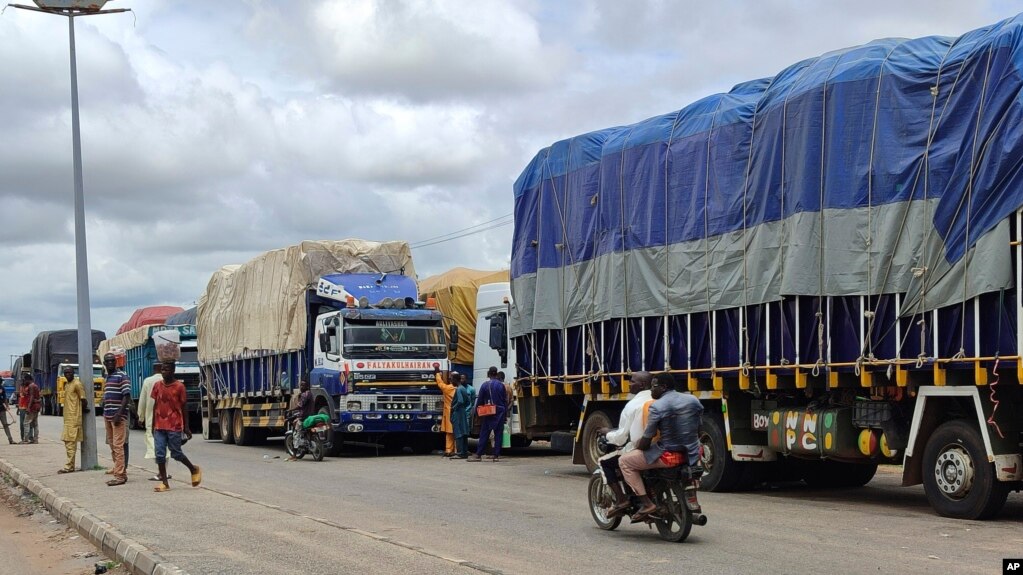
Photo Source: VOA publication, Niger Junta Defies ECOWAS and International Community Pressure