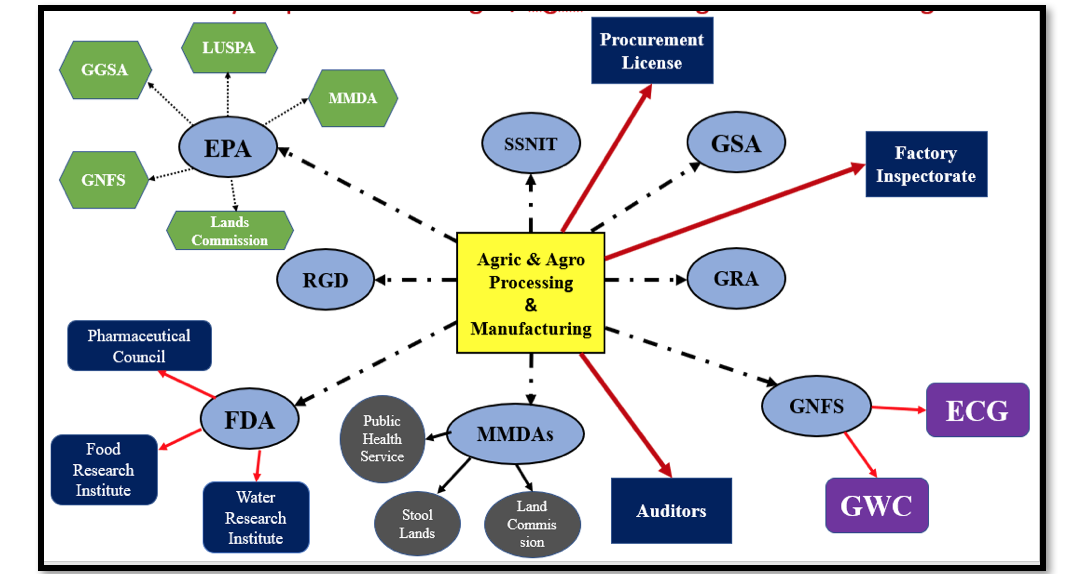
Regulatory frameworks are claimed to play a key role in shaping business environments, ensuring consumer safety, and fostering economic growth. In Ghana, the Food and Drugs Authority (FDA) is the statutory body under the Ministry of Health that oversees the regulations of food, drugs, cosmetics, and household chemical substances. Additionally, the process of business registration is overseen by the Registrar General's Department (RGD). The first step one needs to take to have a product approved by the FDA is to have a business entry certificate. Navigating these regulatory landscapes, however, can pose significant barriers for businesses, including information gaps. Information asymmetry in business registration and product approval refers to a situation in which business owners or the parties in a transaction have insufficient information about the processes of registering products and innovations which leads to market struggles and growth. These include the number of institutions the FDA works with, durations of interaction with each institution and timelines to issue each license.
Being a key state institution mandated by the Food and Drugs Act, of 1996 (Act 523), and the Public Health Act, of 2012 (Act 851), the FDA is responsible for enforcing regulations that ensure the safety, efficacy, quality, and labelling of food, drugs, cosmetics, medical devices, and household chemical substances. The primary laws governing FDA activities include the following:
Product Registration: Before any food, drug, cosmetic, or medical device hits the Ghanaian market whether imported or locally manufactured must undergo rigorous registration processes with the FDA which involves submitting detailed documentation regarding the product's composition, manufacturing process, labelling, and safety data.
Labelling Requirements: Products must comply with specific labelling requirements set forth by the FDA. Labels must include information such as ingredients, expiration dates, dosage instructions, and any potential hazards or side effects.
Good Manufacturing Practices (GMP): Manufacturers must stick to GMP standards to ensure that products are consistently produced and controlled to meet quality standards. Inspections are conducted by the FDA to verify compliance with GMP guidelines.
Import and Export Regulations: Importers and exporters of food, drugs, cosmetics, and medical devices must obtain permits from the FDA. These permits may be subject to specific conditions and requirements to ensure product safety and quality.
The growth of the digital world is expected to reflect in the operations of state service providers like the FDA of Ghana where all business and product registration information can be accessed on their digital platforms by business owners and prospective ones in the food and drugs ecosystem. An analysis of the fdaghana.gov website shows it is one of the state institutions doing well with information on their operations, and document operators in the food and drugs value chain to have their products approved for public consumption. It is commendable that the FDA has the necessary details on their mandates listed on their website such as the size of the company and type of product with their various approved fees. Another check on their Facebook page shows their activeness on the platform which is one of the most used social media portals in the country, which is usually used to sensitize the public about the need to register products with the FDA and update Ghanaians about public exercises and activities on food safety.
Barriers to FDA compliance and business registration
Complex Regulatory Procedures: The regulatory processes for FDA compliance and business registration in Ghana can be complex and time-consuming, especially for small and medium-sized enterprises (SMEs) with limited resources and expertise. The costs associated with FDA registration fees, GMP compliance, and business registration fees can be prohibitive to businesses, particularly startups. Business owners are forced to fall on middlemen to have their products registered as they lack the needed understanding of the processes to navigate the administrative bottlenecks. This poses a challenge to the growth of entrepreneurship and burdens citizens with high product costs since the cost of navigating these administrative processes will be transferred onto the products.
Although the FDA updates its website regarding regulatory requirements and procedures for certifying products, some information is missing. For instance, the durations of securing the certifications are unknown and there’s no doubt this exacerbates the challenges faced by businesses in Ghana. Information on the duration of the Progressive Licensing Scheme for Small and Medium Enterprises (SMEs) is found in its 2022 Annual Report. The FDA has contacts, listed on its website and social media handles but it is difficult to get the needed answers to questions and enquiries which can lead to compliance failures and legal repercussions. Emails and WhatsApp messages are not answered or take days, weeks or even months to receive responses. The response to phone calls is swift, however, one will be asked to first send details of the enquiry on WhatsApp or email feedback, and business owners are forced to travel long distances to their district offices to seek answers to information that are technical.
Comparatively, in Nigeria like Ghana, regulatory bodies such as the National Agency for Food and Drug Administration and Control (NAFDAC), and the Corporate Affairs Commission (CAC) oversee compliance and business registration, respectively. Their website also has the necessary information on business certification including the breakdown of every step of the duration which is 90 working days starting from the day of accepting the application to register a product. Both Ghana and Nigeria have not-so-smooth navigation on their websites as there exists more information on their governance structures than providing details to fast-track issuance of licenses.
In contrast, the United States has robust regulatory agencies such as the Food and Drug Administration (FDA) and the Securities and Exchange Commission (SEC), which enforce stringent standards for product safety and business registration. Despite the complexity of regulations, the U.S. offers comprehensive online resources and support services to facilitate compliance and streamline registration processes. However, its website is unfriendly in terms of navigation and finding information on requirements for business certification.
Although information asymmetry is being addressed by the FDA of Ghana, navigating the regulatory landscapes of compliance and business registration in Ghana presents significant challenges for entrepreneurs and businesses. Barriers such as complex procedures, and high costs hinder business growth and innovation. It should be in the interest of the FDA to provide constant updates on business registration requirements to help small business owners grasp a better understanding of the processes to foster business growth and transition. Comparative analyses with countries like Nigeria and the United States underscore the importance of streamlining regulatory processes, enhancing transparency, and promoting fewer administrative processes to foster a conducive environment for business development and economic prosperity in Ghana. The FDA of Ghana needs to take a cue from Nigeria's openness about the duration of the registration process on its websites as this creates room for transparency.
ILAPI Business Registration Observation
Removing Barriers to Doing Business in Ghana
Image Source: https://panafricanvisions.com/wp-content/uploads/2022/08/healths.jpg